
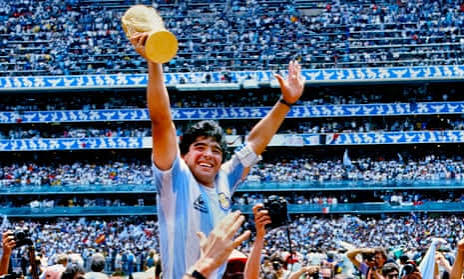
Calling Diego Maradona the man who “almost single-handedly” won the 1986 World Cup for Argentina is more than romantic exaggeration; when you watch those games back, his influence touches almost every meaningful phase of play. Yet his genius did not operate in a vacuum: coach Carlos Bilardo built a structure around him that freed him to roam, draw pressure, and decide matches while the rest of the team quietly did the work that kept Argentina competitive for 90 minutes at a time.
Why Maradona 1986 is still the reference point for individual World Cup campaigns
Maradona scored five goals and provided five assists in Mexico, directly contributing to the majority of Argentina’s goals, including decisive interventions in the quarter-final, semi-final, and final. Beyond raw numbers, his touches dictated tempo, drew multiple defenders, and created space that team-mates repeatedly exploited, turning Argentina’s attack into a moving orbit around one player. For modern viewers, his 1986 run remains the baseline for what it looks like when a single player’s decisions genuinely reshape how an entire tournament feels to watch.
The tactical framework that allowed “solo” dominance
Argentina did not simply give Maradona the ดูบอลโลกสดฟรี 2026 and hope; they set up in a flexible back three/back five with a compact midfield designed to give him platforms to receive and drive at defenders. Bilardo’s system often resembled a 3-5-2 or 3-4-1-2, with Maradona operating as a free central creator behind two forwards, supported by hard-working wide players and disciplined central midfielders. The structure’s purpose was clear: compress space defensively, then give Maradona as many central and half-space receiving points as possible once possession was secured.
How Maradona manipulated space, pressure, and match rhythm
Watching full games, you see Maradona constantly drifting from the centre into half-spaces and wide zones to escape man-marking, dragging his marker into uncomfortable areas and unbalancing the opposition block. His first touch and body orientation regularly put him between lines facing forward, forcing defenders to decide whether to step out and risk leaving gaps or to drop and concede territory to Argentina. This repeated dilemma meant that, even when he did not score, his mere positioning and carrying altered the rhythm and geometry of the match in Argentina’s favour.
Mechanisms that made his “almost alone” carry possible
Several tactical mechanisms amplified Maradona’s influence beyond his own actions. First, forwards made diagonal runs off his shoulder, offering either decoy movements to free him or direct channels for through balls once defenders overcommitted. Second, midfielders like Batista and Giusti protected the central lane behind him, allowing Maradona to gamble higher up without destroying defensive balance. Third, Argentina’s back three stepped in aggressively when he lost the ball, shrinking the space opponents had to counter, which let him take risks knowing the team would often recover quickly.
Watching the England quarter-final as a live-study in Maradona’s range
The quarter-final against England is the purest single-match illustration of how Maradona could decide a contest in multiple ways within minutes. His infamous “Hand of God” goal came from persistent pressure, following up a broken move and exploiting a moment of chaos, while his “Goal of the Century” eleven minutes later showed his ability to coordinate balance, acceleration, and decision-making at top speed. Over 90 minutes, you see him dropping deeper to receive, spinning away from pressure, and repeatedly forcing England’s compact midfield to turn and chase, slowly eroding their structure.
How to watch Maradona’s 1986 matches with a modern analytical eye (ดูบอลสด)
If you rewatch 1986 games—or catch extended highlights—through a modern lens, you can treat them like live tactical case studies rather than just historical clips. Instead of focusing only on famous moments, track how often Maradona gets on the ball between lines, how many defenders converge when he drives, and what his team-mates do in reaction: do they run beyond, pull wide, or recycle possession to reset the structure? When you ดูบอลสด of classic matches like Argentina–England or the final against West Germany with those questions in mind, the “almost alone” narrative becomes more layered, revealing both his extraordinary autonomy and the level of collective understanding required to make that autonomy work across a full tournament.
Tournament contribution table: why the “carried them” label persists
A simple statistical snapshot helps explain why so many people speak of Maradona “carrying” Argentina in 1986, even if the team around him was more structured than that phrase suggests.
| Metric | Maradona 1986 value | Tournament context and viewing takeaway |
| Goals | 5 | Scored in knockouts vs England (2) and Belgium (2), central to progression |
| Assists | 5 | Directly created chances finished by team-mates across stages |
| Goal+assist involvement | 10 total | Directly involved in most of Argentina’s goals, visible in nearly every key move |
| Awards and recognition | Golden Ball winner | Widely recognised as tournament’s outstanding player while captain |
For viewers, these numbers match what you see on the pitch: Argentina had a coherent shape and important contributors, but the decisive actions in tight games kept running through one man.
Where the “almost alone” idea oversimplifies what you see on screen
The romantic story of Maradona winning the World Cup alone can obscure how much his team-mates and coach did to support him, especially in moments when he was crowded out or tired. In the final against West Germany, for example, it was Burruchaga’s run and finish that produced the winner after Maradona drew pressure and slipped the decisive pass, and Argentina’s defensive work under aerial bombardment was a collective effort. When you rewatch full matches, you notice that the side survives long spells without him touching the ball by staying compact, winning second balls, and managing set-pieces, which is why his genius had the platform to decide games instead of being drowned out.
How Maradona 1986 reframes modern “carry” performances
Comparisons between Maradona’s 1986 campaign and more recent stars often miss the tactical context: both eras show teams deliberately built around a focal player, but with different balances between structure and improvisation. Modern sides often protect their stars with more rigid positional play and pressing schemes, whereas 1986 Argentina gave Maradona a wider, looser canvas and accepted the risks that came with it. As a viewer, understanding this helps you judge whether a current “carry job” genuinely parallels Maradona’s—or whether it is happening in a more system-heavy environment where individual freedom is narrower.
Summary
Diego Maradona’s 1986 World Cup remains the clearest example of how one player’s vision, dribbling, and decision-making can dominate a tournament without erasing the importance of the team around him. Argentina’s structure under Bilardo compressed space, protected his risk-taking, and gave him ideal receiving zones, while Maradona repaid that framework with a level of end-product and control that still shapes how we watch Argentina’s greats today. When you revisit those matches with attention to positioning, pressing, and off-ball movement as well as moments of magic, the phrase “almost single-handedly” starts to look less like myth and more like a shorthand for a rare, tournament-long alignment between one genius and a system built to let him decide the biggest games.