
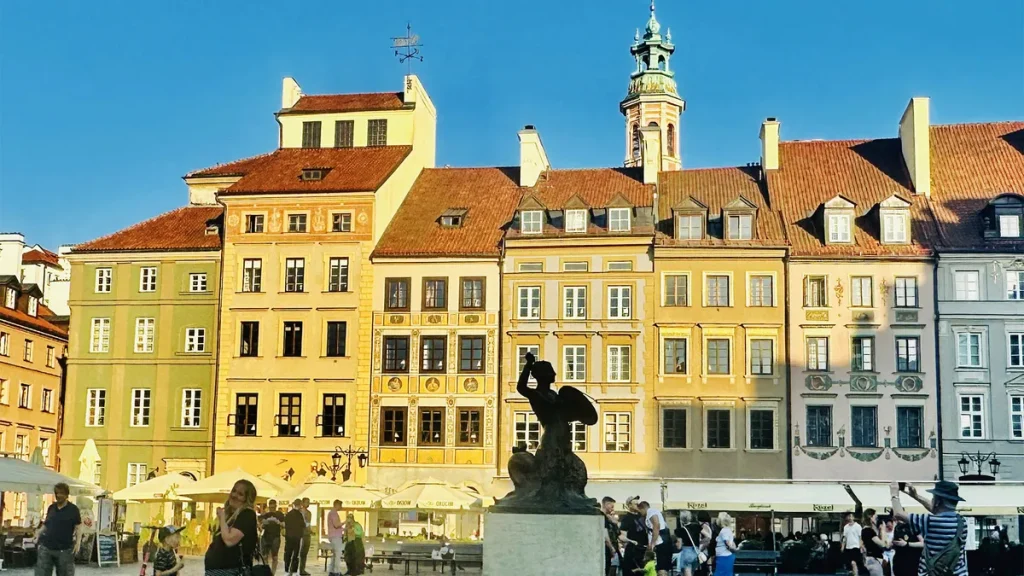
Warsaw is often introduced through a familiar set of landmarks: the Old Town, the Royal Route, the Palace of Culture, and a few major museums. These places matter, but they do not explain the city in full. To understand Warsaw more deeply, it is worth stepping outside the standard route and looking at the spaces where memory, change, and daily life meet. In that wider urban picture, just as people move between routine and distraction online through things like fortune gems 2 online, they also search in real cities for places that feel less scripted and more revealing.
What makes Warsaw interesting is not only what survived history, but also what was rebuilt, redefined, and repurposed. This is a city where postwar planning, local identity, culture, and public space continue to shape one another. For that reason, some of the most memorable parts of Warsaw are not the postcard locations, but the districts, courtyards, riverbanks, markets, and social spaces that show how the city actually works.
Praga: A District That Preserves a Different Urban Memory
If a visitor wants to see a side of Warsaw that feels less formal and more layered, Praga is one of the strongest choices. Located on the eastern bank of the Vistula, this district long developed differently from the center. It escaped part of the wartime destruction that reshaped much of Warsaw, which means its streets, buildings, and courtyards often preserve an older urban texture.
Praga is not important because it is “hidden.” It is important because it reveals a different historical rhythm. Walking there, one notices brick facades, side streets, small workshops, chapels in courtyards, and a street pattern that feels less monumental than central Warsaw. This is also where many artists, small galleries, bars, and independent cultural spaces found room to grow. The district shows how a city can carry memory not only through monuments, but through ordinary built form.
The Vistula Riverbanks: Public Space as a Sign of Urban Change
For many years, visitors focused on Warsaw’s monuments more than on its river. That has changed. Today, the Vistula riverbanks are among the most telling places in the city because they reflect how Warsaw has learned to use open public space in a new way.
The left bank includes promenades, cycling routes, seasonal meeting points, and views across the water. The right bank remains more natural in parts, which creates a contrast rare in large capitals. This balance between designed public infrastructure and open landscape gives the river area a special role. It is not only a place to walk; it is also a place to observe the city’s social life.
Here Warsaw becomes easier to read. Residents run, meet friends, rest by the water, move between districts, and use the river as part of daily life rather than as a decorative background. For a visitor, this is one of the clearest ways to understand the city beyond museum narratives.
Powiśle: Between the Center and Everyday Life
Powiśle is another area that deserves more attention than it usually gets in standard travel guides. It lies close to central landmarks, yet it offers a very different experience. Historically shaped by industry and infrastructure, it has gradually become one of the city’s most interesting mixed-use areas.
What makes Powiśle valuable is the combination of layers. University life, residential streets, green areas, renovated buildings, cafes, cultural venues, and access to the river all exist within a compact zone. The district does not rely on a single attraction. Instead, it works as an example of how urban identity is built through overlap.
A walk through Powiśle helps explain contemporary Warsaw better than many official sites do. It shows how the city has moved beyond simple reconstruction toward adaptation and reuse. It also demonstrates that urban appeal often comes from coherence, not spectacle.
Hala Koszyki and Old Market Spaces Reimagined
Many cities have restored market halls, but in Warsaw such spaces are especially meaningful because they reflect the city’s broader pattern of rebuilding and reinterpretation. Hala Koszyki is one example of how an older structure can be turned into a new public meeting point without losing its urban role entirely.
Even more interesting than the building itself is what it represents: the shift from purely functional space to social space. This is a key theme in modern Warsaw. Formerly practical urban sites are increasingly being used for gathering, conversation, food culture, and small-scale city life. Visitors who want to see how Warsaw functions in the present should pay attention to such places, not just to historic icons.
Local Parks and Cemeteries as Historical Texts
Warsaw can also be read through quieter spaces. Parks such as Park Skaryszewski or less central green areas often reveal more about local life than the most photographed squares. These spaces are used by residents across age groups and connect the city’s built environment with slower rhythms.
The same is true of historic cemeteries, especially Powązki. While not part of every tourist plan, such places provide a direct connection to Polish cultural memory, intellectual history, and national symbolism. They are not simply sites of burial. They function as archives of the city’s social and political past.
For a visitor interested in analysis rather than checklist tourism, these quieter places are essential. They shift attention from consumption to observation and from attractions to context.
Museums Outside the Standard Route
Warsaw’s best-known museums attract deserved attention, but smaller or more specific institutions can often leave a stronger impression. Museums devoted to daily life under communism, local district history, or social experience provide detail that large national narratives sometimes flatten.
These places matter because Warsaw is not a city understood through one story. It is shaped by occupation, destruction, socialist planning, democratic transition, and rapid modernization. Smaller museums often present one fragment of that process more clearly than broader institutions can.
Why the Non-Obvious Warsaw Matters
The most surprising side of Warsaw is not hidden in a secret location. It appears when a visitor stops treating the city as a list of landmarks and starts reading it as a living structure. Districts like Praga, public zones along the Vistula, layered neighborhoods like Powiśle, reimagined market halls, local parks, and smaller museums all help explain how Warsaw developed and why it feels distinct today.
To look beyond standard tourist places in Warsaw is not simply to avoid crowds. It is to see the city on its own terms: as a place where rupture and continuity exist together, where public space carries meaning, and where everyday urban life reveals as much as official history.